Why Zohran Mamdani may not be sworn in as New York 111th mayor after shocking detail emerges
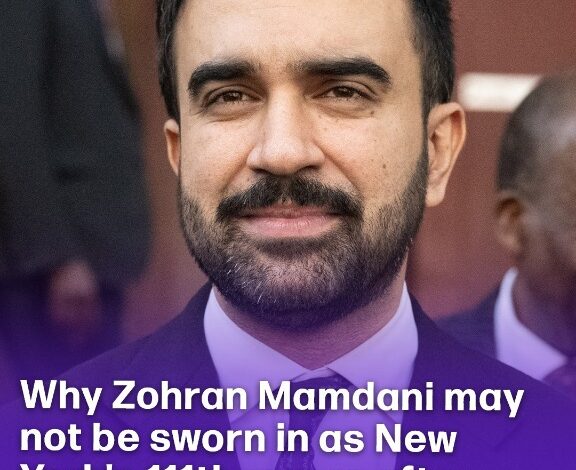
Zohran Mamdani’s victory electrified New York City the moment the results became official. At just 34, he broke through every political ceiling the city had leaned on for generations—New York’s first Muslim mayor, its first South Asian mayor, and the first mayor born on the African continent. His win wasn’t just a political shift; it was a cultural turning point in a city built on diversity yet historically hesitant to hand the top job to someone who embodied it so completely. As he prepared for his January 2026 inauguration, the city hummed with a sense of change. But then, out of nowhere, an academic footnote exploded into a full-blown controversy that no one could have predicted.
The discovery came from historian Paul Hortenstine, who had been buried in archives researching early New York mayors and their ties to the transatlantic slave trade. While combing through records from the 1600s, he stumbled on a detail everyone else had missed. Matthias Nicolls—listed as New York City’s sixth mayor—had actually served two nonconsecutive terms, one in 1672 and another in 1675. The problem? The city had always counted them as one.
By modern standards, each mayoral term is supposed to be counted separately. Presidents are numbered by terms; so are governors and many major city mayors. Based on that rule, New York’s entire count had been off by one for more than 350 years.
It meant that the incoming “111th mayor” wasn’t the 111th at all. In strict historical terms, Zohran Mamdani was actually the 112th.
Hortenstine didn’t sit on the information. He alerted the mayor’s office, provided scanned documents, and traced the error back to an administrative oversight from the 17th century that was copied, recopied, and eventually cemented into tradition. Surprisingly, this wasn’t even the first time someone noticed. In 1989, historian Peter R. Christoph flagged the same discrepancy and asked how nearly a hundred mayors had been misnumbered. But the city brushed it off. The mistake survived simply because no one wanted to rewrite hundreds of years of records.
Now, with Mamdani’s historic election making headlines nationwide, the old clerical error resurfaced with sudden weight. City Hall found itself fielding questions about whether the official list should be corrected once and for all. Archivists, historians, and curious New Yorkers all weighed in: Should the city fix the count and acknowledge Nicolls’s second term? Or leave the numbering intact as a piece of historical inertia?
The revelation stirred more curiosity than outrage. Some New Yorkers laughed it off as an absurd twist only this city could produce. Others were stunned that an error this old had gone unchecked in a place known for meticulous recordkeeping. And plenty argued the correction was long overdue—not to change Mamdani’s role, but to uphold historical accuracy.
A few joked online that Mamdani had unlocked yet another “first”: the first mayor to inherit a 350-year-old numbering dispute.
But beneath the humor sat a real debate. Renumbering the mayors would ripple through museums, public plaques, school textbooks, and decades of ceremonial materials. It wasn’t just adjusting a number—it was rewriting how the city documented itself.
Meanwhile, Mamdani pressed on, unbothered by the noise. His transition team focused on the real-world crises waiting for him: housing affordability, public transit failures, neighborhood safety, economic recovery, climate resilience, job creation. Press conferences centered on policy, not the suddenly contested number attached to his title. When asked, he responded with a light smile and a reminder that leadership mattered far more than the figure printed on a banner.
Behind closed doors, historians debated the issue with more seriousness. Some argued that accuracy in historical records is nonnegotiable. Others insisted that after 350 years, changing the numbering would create more confusion than clarity. New York’s identity is built on layers—messy, flawed, constantly evolving. Fixing the list now might unravel more than it repaired.
Hortenstine, however, viewed it as a matter of principle. His push for correction wasn’t political or tied to Mamdani personally. He believed historical truth should stand even when inconvenient. For decades, historians like Christoph had quietly pointed out the error. But now, with the mayor-elect drawing worldwide attention, the moment felt right for the city to confront its overlooked details.
As the inauguration approached, the story shifted from an archival curiosity to a bizarre subplot in one of the most symbolic mayoral transitions in modern New York history. Local news ran segments outlining the mistake with equal parts fascination and humor. National outlets treated it as a quirky footnote about a bureaucracy so old it accidentally rewrote its own timeline.
Through all the debate—serious, comedic, and everything in between—Mamdani stayed focused. Whether he was the 111th or the 112th mayor didn’t change the mandate voters had handed him. It wouldn’t alter the city’s budget, his executive authority, or the crises he was about to inherit. What mattered was the job ahead, not the ceremonial number pinned to a podium.
Still, the timing of the discovery carried symbolism. It reminded New Yorkers that their history, like the city itself, is perpetually under revision. Records evolve. Mistakes surface. Truths shift as new evidence comes to light. And sometimes, the most unexpected story of a transition isn’t about politics, identity, or power—it’s about a forgotten ledger from the 1600s.
By the time Mamdani stands to take the oath of office, the numbering debate may still be unresolved. But New Yorkers will be watching a new chapter unfold, shaped by the man they chose to lead them rather than by a centuries-old clerical miscount.
Whether the city embraces the correction or clings to tradition, the moment has already woven itself into the complicated tapestry of New York history. The footnote will linger, debated and joked about for years, but it won’t overshadow the real significance of Mamdani’s election—or the work that comes next.
As New York prepares to swear in a groundbreaking mayor, the ancient error stands as a reminder that even the smallest details can rewrite how a city sees itself. In a place constantly redefining its identity, even the fine print matters—because the story of New York is never finished, and every overlooked detail eventually demands to be heard.